
How we are harnessing the ‘AI Chaos’ in service of quality healthcare access, written by Yohann Richard, AI Engineering at Audere
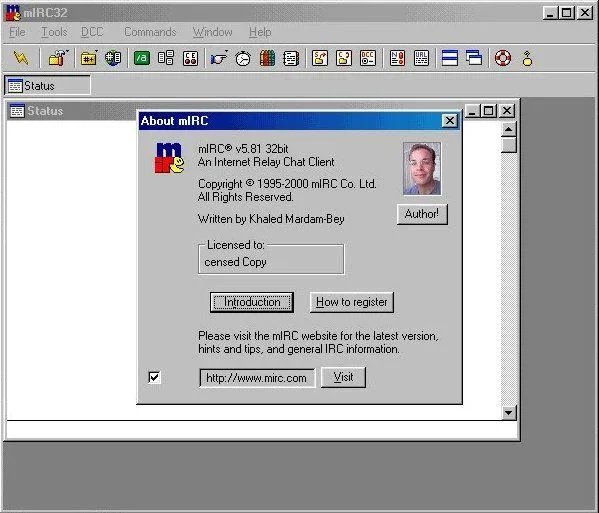
An mIRC chatbot is an automated script or program running inside mIRC (a Windows Internet Relay Chat client) that listens to chat events and posts automated replies or performs actions.
I built my first chatbot in the 90s. It lived on mIRC.
No machine learning. Just regex, a keyboard that clacked like a pickaxe hitting rock, and a few tricks borrowed from ELIZA, the 1960s “therapist” bot that turned your sentences back into questions. Caveman coding, basically, chiseling out gross, ugly code by hand. I’d let it run overnight and grin every time someone chatted with it before realizing they’d been fooled.
I kept following the field for the next thirty years, including the Loebner Prize era — an entire competition built around whether a machine could pass for humans. Wild, in hindsight, how much energy went into making machines seem human. The hard part today isn’t that anymore.
“Wild, in hindsight, how much energy went into making machines seem human. The hard part today isn’t that anymore.”
Fast forward to Audere, a nonprofit working on healthcare access across Africa. GPT-3.5 shipped, and I remember bringing it up to Dino, our CEO, on a call in mid-2023, asking why, with everything going on in advancing large language models (LLMs), we — a company already leading on computer vision AI — weren’t leveraging it too. Credit where it’s due: he gave us the room to go chase the opportunity, and expand the use cases leveraging AI-powered services we deliver.
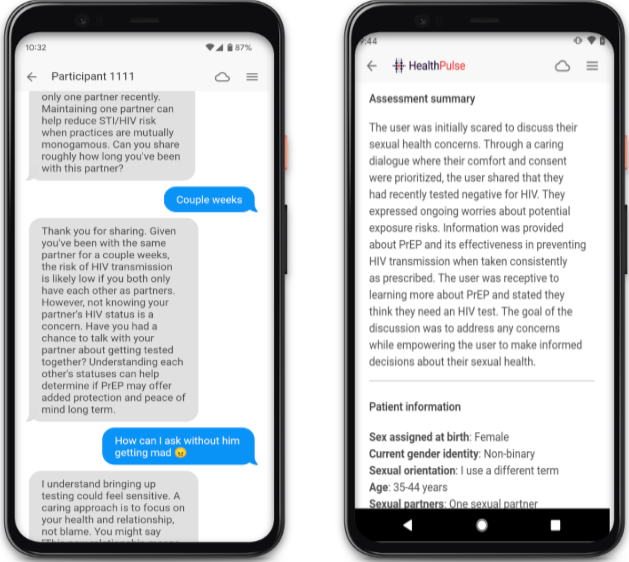
Audere already had a React Native library to quickly spin up mobile apps leveraging our on-device computer vision RDT interpreter, so as our first experiment, we bolted integration to 3 LLMs on top to enable AI powered natural language conversations, structured data extraction from the conversation and a summarization function for the conversation, and tried out with a group of patients and healthcare workers (under IRB) in South Africa [1].
We also saw the limits fast — the randomness, guardrails that barely held, token costs stacking up, the random hallucinations trying to fill the gaps, the complete ‘Wild West’ of it all at the time, late 2023. Funny thing, a PhD-level model can outperform clinicians on answering medical questions, and yet, still say the dumbest thing at the most unexpected time — I know you know that feeling too. Funnier still, even with this truth, people were talking about the coming tech market crash back then, same as now.
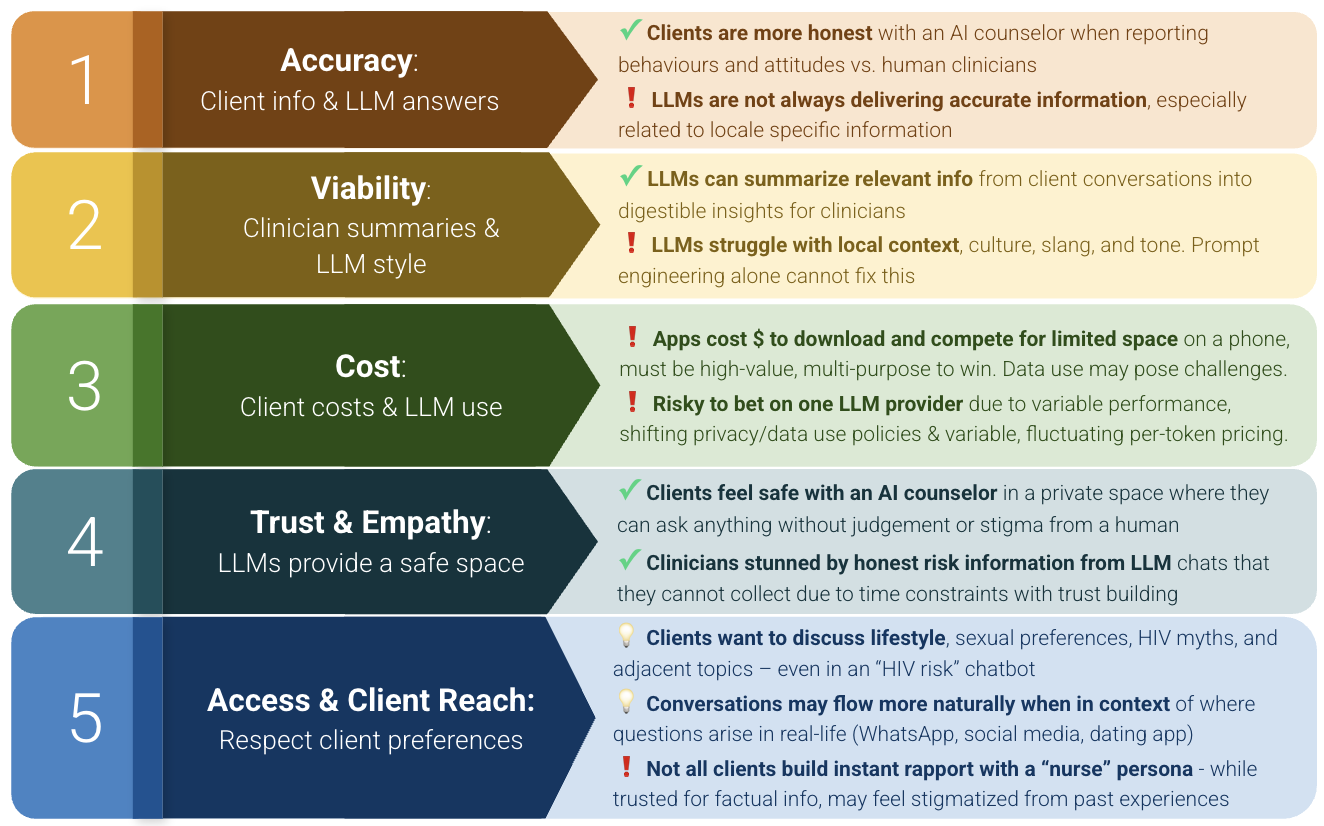
A summary of learnings from our first LLM powered companion research, Your Choice, in partnership with Indlela Behavioural Science at Wits Health Consortium and CHAPS (the Centre for HIV Prevention and Studies) in 2023.
In retrospect it’s obvious now, but we immediately got a positive signal from our experiments. People loved the experience — patients loved the anonymity, it let them feel comfortable sharing and asking questions about their ailments to a faceless AI, without any judgement. From the healthcare worker side, in a country where they’re often understaffed and overwhelmed, the need for support triaging patients — figuring out who needed to be reached out to and directed toward tests and treatment early — was immediate too. That first experiment unlocked a lot more donor and partner interest, and a deeper investment in the infrastructure and population targeted studies.
That initial prototype has evolved over the last few years to what is now a WhatsApp platform deployed in South Africa, Zimbabwe, and Mozambique, with 220,000+ users, 60%+ with meaningful engagement, country-specific RAGs, multilingual support for low-resource languages, a hybrid evaluation framework for LLM selection and ongoing monitoring, and multiple model providers running side by side so the 24/7 service doesn’t go down when a model has an outage. This month we also crossed 3 million malaria RDTs read on the platform in the field, a meaningful milestone for deterministic AI in a world increasingly obsessed with what generative models can do.
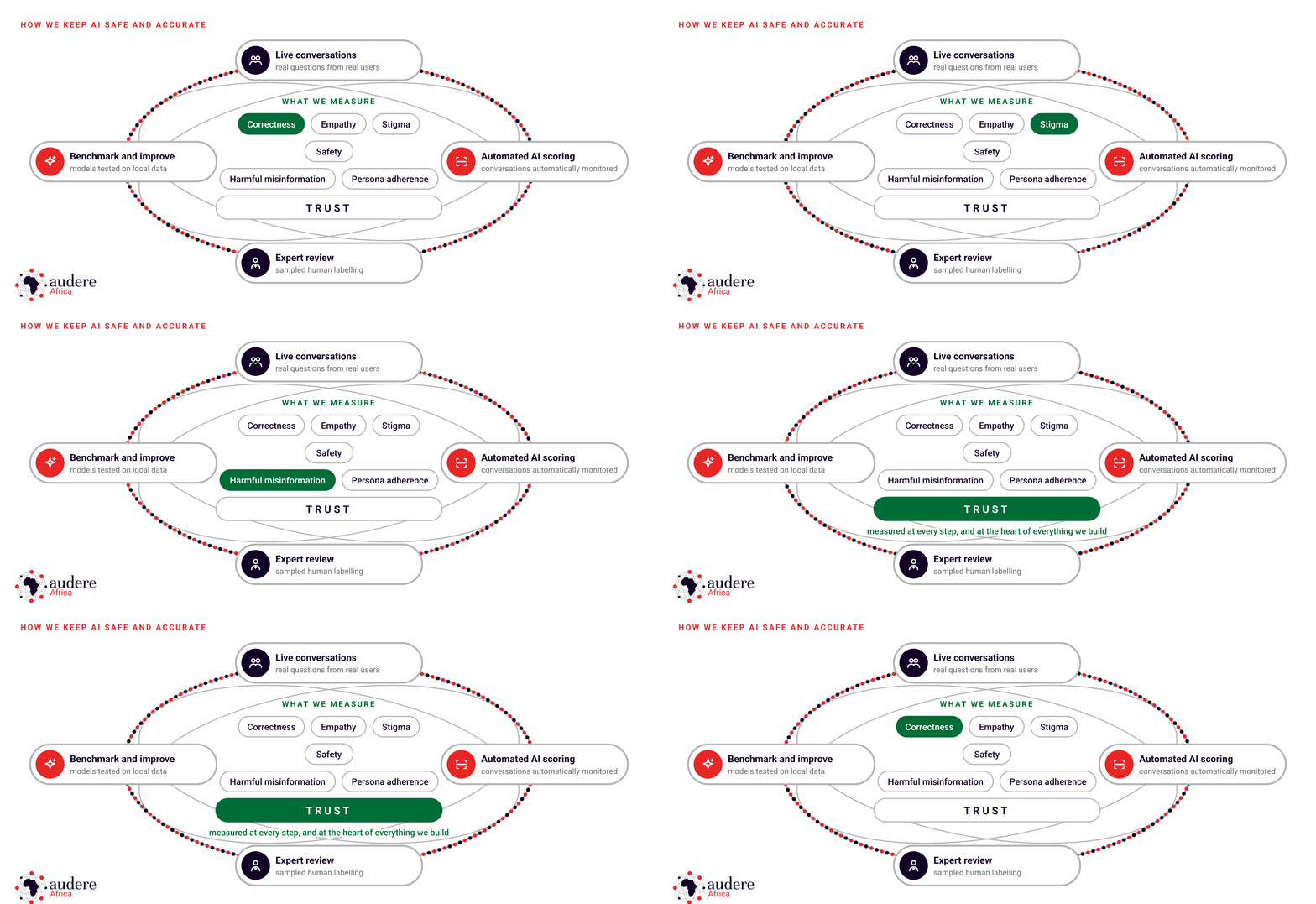
At Audere, safety IS the product, so the platform is supported by a full set of AI-powered skills, agents, and tools that run massive regression tests and automate much of our feature building, testing, and validation. While I recognize that we’re not the first, nor the last to develop such a mature platform, there’s real satisfaction in going from early idea and testing, to just a few years later, now watching the ‘factory’ push code out, optimizing and iterating its own workflow, and inch toward repeatability and reliability of outcome which is absolutely crucial in the world of healthcare delivery.
This is the first in a series of blogs we’ll share diving into the challenges we’ve encountered, what we’ve tried, what’s worked and what hasn’t. Our hope is that in sharing, others will learn, share their own reflections, and together we’ll move forward more informed, and more efficiently as we endeavor to expand access to quality care with AI.
[1] Your Choice publication- https://www.frontiersin.org/journals/digital-health/articles/10.3389/fdgth.2025.1731002/full