
How AI "Besties" in South Africa Are Changing Uptake of HIV Medication
Chatbot companions, such as Aimee, are part of a broad wave of digital health tools being tested across HIV programs
This article first appeared March 19, 2026 in Think Global Health, read the full article here.
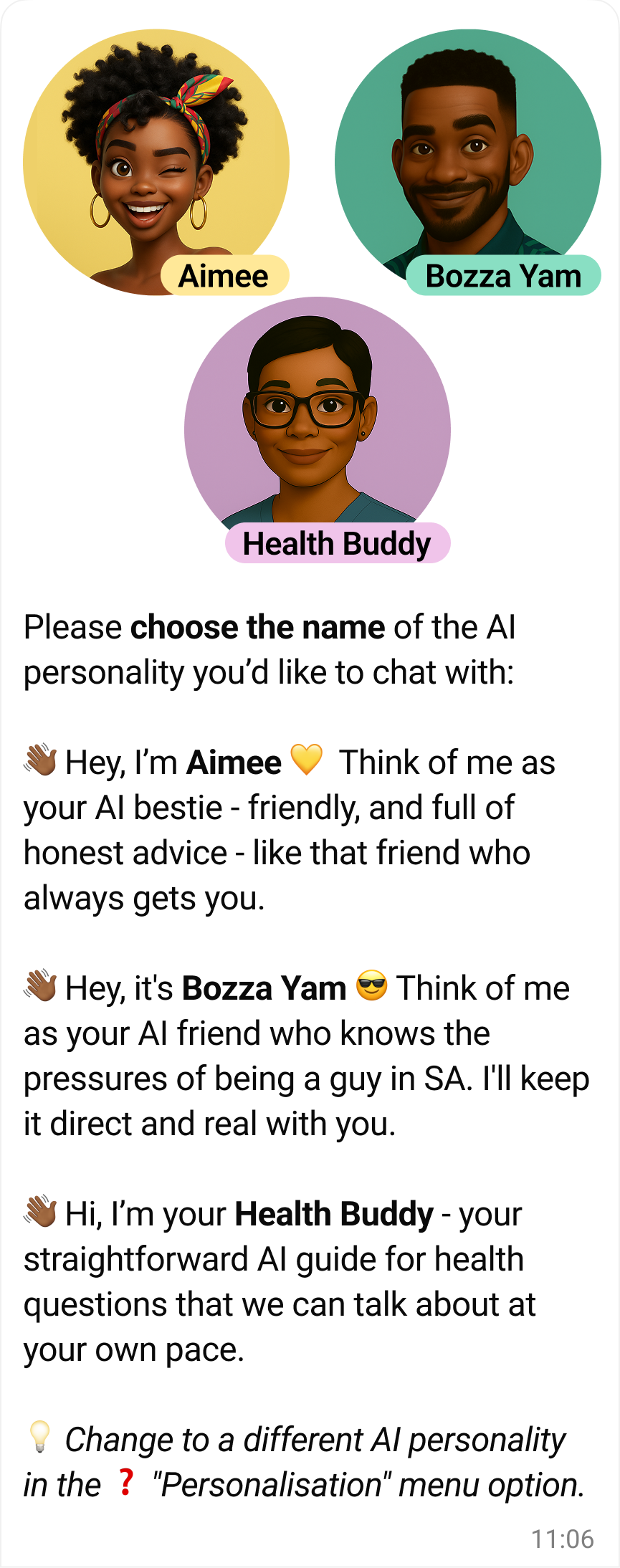
An image from the Self-Cav AI chatbot which shows the various AI personas that clients can interact with.
The public health field is preparing for what could be the most important advance in HIV prevention in more than a decade: the rollout of lenacapavir, a twice-yearly injectable with the potential to expand access to long-acting pre-exposure prophylaxis (PrEP). Yet history shows that even the most effective products fall short when systems and support structures don't align with realities of people's daily lives.
Oral PrEP has illustrated this clearly: despite global approval in 2012 and strong evidence of efficacy, uptake has remained uneven due to persistent behavioral, social, and structural barriers. These challenges offer lessons for the rollouts of any next-generation PrEP modalities.
For long-acting PrEP, success will depend on something less visible: whether health systems can respond to the everyday questions, fears, and decisions that shape whether people start—and remain on—prevention. Preparing for this question requires real-time insight into how people experience HIV prevention, where trust breaks down, and what support actually changes behavior. This is where digital-relationship-based tools—such as artificial intelligence (AI) chatbots supported by large-language models (LLMs)—come into play.
Non-AI chatbots have been used across health sectors for more than a decade, but rigorous evidence on the technologies' effectiveness, acceptability, and integration into routine health programming remains limited, especially for nascent LLM-driven chatbots. Traditional and AI chatbots have been deployed in South Africa, Kenya, Nigeria, and Tunisia, supporting health education, counseling, screening, and information provision across HIV, maternal and general health, and COVID-19. Implementation has relied on text messaging services and WhatsApp, and multilingual support for accessibility to reach diverse populations.
Aimee as a Digital Entry Point to Primary Care
Evidence from South Africa's Aimee program offers a glimpse into how digital tools could support the next generation of HIV prevention. Aimee is a WhatsApp-based AI health companion developed by the nonprofit Audere Africa and the youth-centered health service SHOUT-IT-NOW, which provides confidential, 24/7 guidance on HIV prevention, sexual health, and mental well-being. Because Aimee operates on WhatsApp—already widely used among young people—it removes many of the barriers that limit adoption of other digital health tools.