
How AI and data can change the fight against Malaria in Kenya
Read the full story
You can also watch a film series about this program and its impact here
Nearly 40% of suspected malaria cases in Kenya's private sector go unreported. Antimalarial drugs are often prescribed without testing. These gaps mean patients get incorrect care and health authorities lack a complete picture of where malaria is spreading, making targeted resource allocation nearly impossible.
The challenge
Malaria remains one of the leading causes of illness and death across sub-Saharan Africa. Patients are often treated based on symptoms alone rather than diagnostic confirmation. In the private health sector – chemists and private providers—case data typically never reaches national reporting systems, creating critical blind spots in disease surveillance. Without diagnostic data, health systems can’t see where malaria is actually concentrating. Resources get wasted. Cases multiply unseen.
A collaborative solution
In May 2024, Kisumu County Department of Health partnered with PharmAccess and Audere to launch a digital malaria case management project. This partnership is supported by European and UK funding (DIDIDA). The initiative introduced HealthPulse, an AI-powered app providing real-time decision support for malaria testing and treatment.
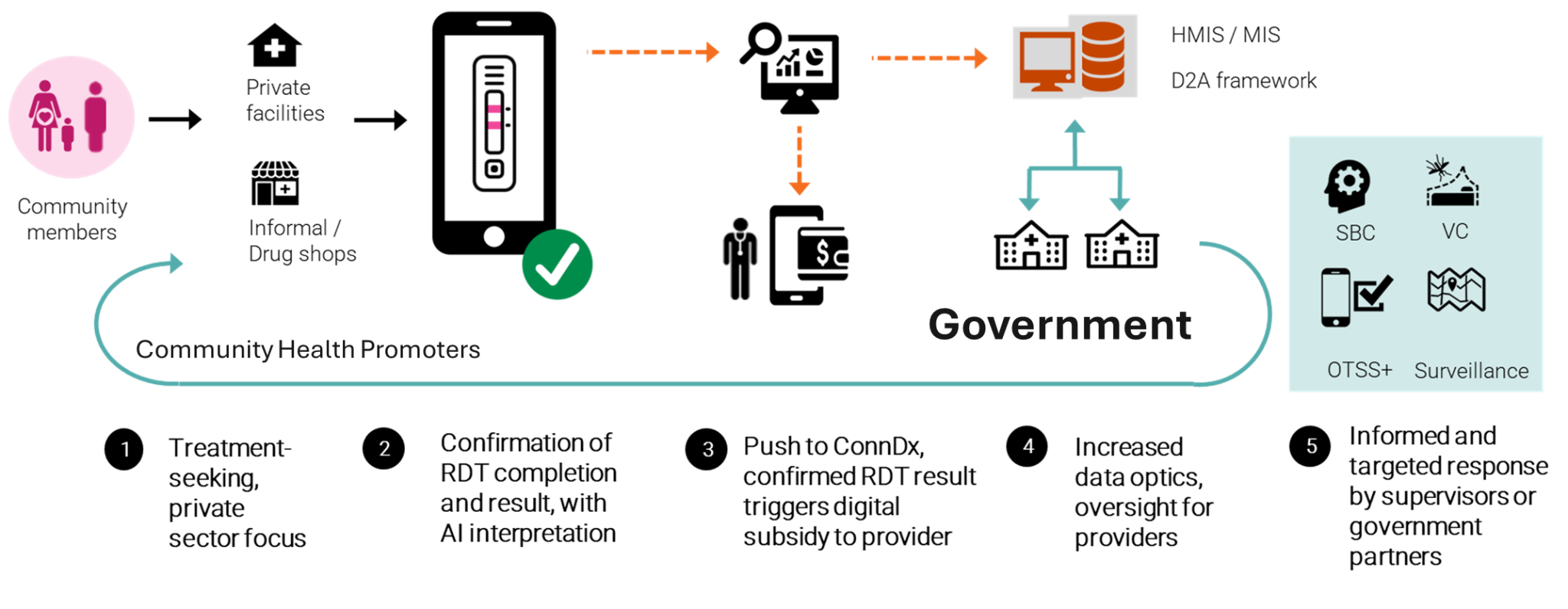
Working through a hub-and-spoke model, trained private health providers collaborate with community health promoters and chemists. This network ensures patients with fever receive proper testing before treatment, are referred to clinics when necessary, and that every test result feeds into a shared pool of real-time health data.
How HealthPulse works
When a patient visits a participating provider, HealthPulse guides them through the testing process. The app collects essential patient information, then provides step-by-step instructions for up to ten WHO-approved malaria rapid diagnostic tests. A built-in timer and a dedicated coding system ensure accuracy and prevent misuse.
Once complete, the provider photographs the malaria test result. The app’s AI interprets the image instantly, reporting positive, negative, or invalid results and recommending next steps: treatment with approved antimalarial drugs or referral to a health facility.
All data flows securely to a location-based, real-time dashboard, giving Kisumu County unprecedented visibility into malaria trends. Providers receive digital incentives through mobile money and data bundles, rewarding sound malaria management practices:
Key features
Built for low-resource and remote settings, HealthPulse includes:
AI-driven interpretation reduces human error and identifies (re-)training options by automatically reading diagnostic test images with high accuracy.
Guided test administration with on-screen timers and clear instructions ensures correct performance.
Offline functionality allows use in areas with limited internet access.
Automatic data integration connects results to national health systems like the national KHIS2.
Supervisors can monitor providers in near real time. Each test receives a unique identifier, preventing misuse and maintaining data quality. The app also tracks medicine prescription when tests are negative – data that informs broader fever management policies and referrals.
The dashboard
All data feeds into an interactive PowerBI dashboard created by PharmAccess. County health officials access health intelligence data such as test positivity rates, age, pregnancy and gender distribution, and testing trends across time and geography. The dashboard monitors provider performance and data quality, enabling quick identification of gaps and targeted training.
Impact and results
By June 2025, just ten months into the pilot, the results speak for themselves:
Over 26,000 accurate malaria tests were conducted in private sector.
A total of 96 frontline healthcare workers, including laboratory technicians, chemists, and community health promoters completed training and actively used HealthPulse.
The app’s AI identified incorrect human interpretation 1% of the time.
Real-time data from the private sector began flowing into Kisumu County’s official health reporting system for the first time.
For patients, this means faster and more accurate diagnosis, higher quality of care. For the health system, it means better surveillance, more efficient resource use, and fewer missed cases. For the providers it means increased quality, credibility, patient flow and remuneration. This approach reduces costs of comprehensive malaria care with minimal 25%.